


A New Logo for a New Mission: LICI Shifts Focus to Saving the Abbeville Red Iris
- Apr 20
- 4 min read
Updated: Jun 3
April 20, 2026 — New Orleans, La.
The Louisiana Iris Conservation Initiative (LICI) was originally founded with the broad mission of conserving Louisiana’s native iris species and restoring populations of the giant blue iris, Iris giganticaerulea, along Louisiana's Gulf coastal region. Over the last two years, however, the organization’s efforts have increasingly focused on one of Louisiana’s rarest and most threatened native plants — the Abbeville Red iris, Iris nelsonii, a species of the Louisiana iris.
That evolution in purpose is now being reflected in LICI’s identity through a redesigned logo symbolizing the organization’s growing commitment to restoring the Abbeville Red iris within its only natural habitat: the Abbeville Swamp near Abbeville, Louisiana.

Photo on left: Prior to April 2026, the Louisiana Iris Conservation Initiative’s (LICI) logo featured the “Giant Blue” Louisiana iris species, Iris giganticaerulea.
Unlike the giant blue iris, which once covered vast stretches of Louisiana wetlands, the Abbeville Red iris exists naturally in only one place on Earth — a 1,200-acre privately owned cypress-tupelo swamp in Vermilion Parish. Scientists consider the species critically imperiled because of its extremely limited
range and the environmental pressures affecting the swamp.

LICI’s growing involvement with the species began through seed collection efforts and restoration plantings designed to establish a protected population outside the swamp while eventually returning propagated plants back into their native habitat. In recent years, the organization has worked with partners at Palmetto Island State Park to establish a major planting of the Abbeville Red iris within the park’s boardwalk swamp.
LICI volunteers have collected thousands of seeds from the Abbeville Swamp, grown young irises in the organization’s nursery, and then planted the mature Abbeville Red irises into the boardwalk swamp at Palmetto Island State Park. The long-term goal is to develop populations large enough that divisions of verified Iris nelsonii plants can eventually be replanted into portions of the Abbeville Swamp itself.

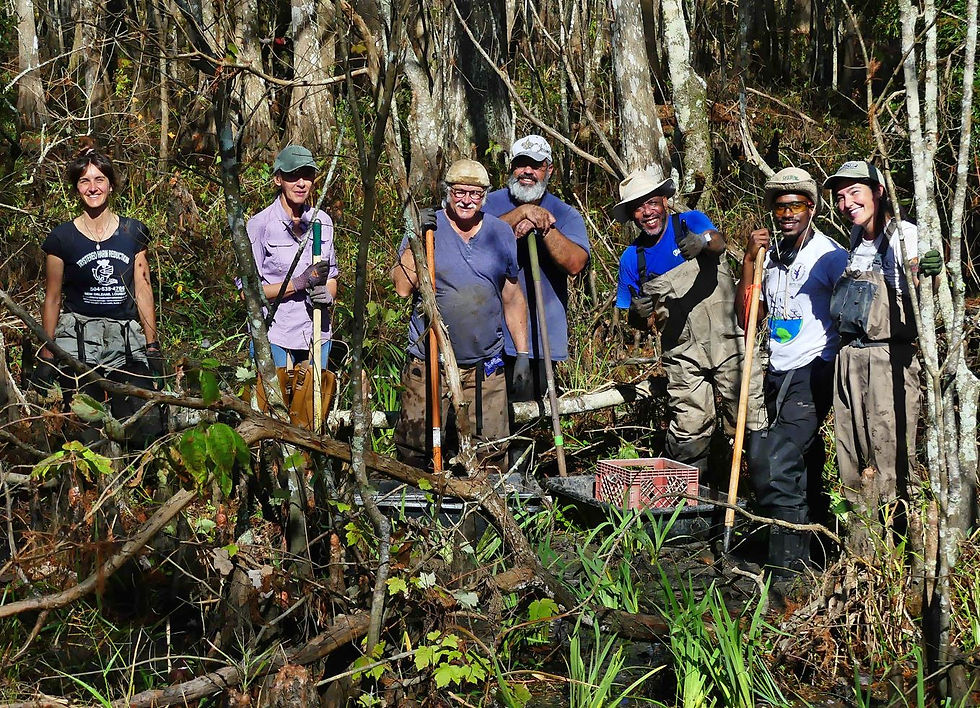
Additionally, with the support of the largest landowner, LICI has taken the lead in bringing together volunteers to enter the Abbeville Swamp to investigate the causes behind the iris’ decline and identify possible solutions to reverse the trend. Those efforts have resulted in presentations to the Coalition to Restore Coastal Louisiana (CRCL) and the USDA’s Natural Resources Conservation Service (NRCS), outlining proposed solutions to the problem. Following one presentation, a diverse group of NRCS scientists and staff visited the swamp to observe conditions firsthand.
According to LICI president Gary Salathe, the organization’s new logo reflects the group’s changing direction toward the restoration of the Abbeville Red iris, symbolized by replacing the blue Iris giganticaerulea bloom in the logo with a photograph of the red iris.

“When LICI first formed, much of our work focused on rescuing and replanting giant blue irises along Louisiana’s coast,” Salathe explained. “But as we became more involved with the Abbeville Red iris and saw the increasing threats to its habitat, our mission naturally evolved. The new logo represents our commitment to restoring the Abbeville Red iris in the swamp where it originated.”
The logo redesign also serves as a reminder that conservation priorities can change as environmental conditions worsen and new threats emerge. Rising tidal influence, saltwater intrusion, erosion, and changing hydrology have pushed the Abbeville Red iris close to extinction within the Abbeville Swamp ecosystem, increasing the urgency of restoration efforts.
The Abbeville Red iris occupies a unique place in Louisiana’s natural history. First discovered in the 1930s, the species is believed to have originated as a naturally occurring hybrid involving several Louisiana iris species, including the “Giant Blue” iris, Iris giganticaerulea. Over time, the iris adapted to the unique environmental conditions of the Abbeville Swamp, eventually stabilizing into a distinct species now known as Iris nelsonii. Its striking red blooms, rarity, and scientific importance have made it one of Louisiana’s most celebrated native plants.

For LICI, the logo change represents far more than a graphic update. It marks a transition from broad coastal iris rescue efforts toward a focused campaign aimed at ensuring future generations will still be able to see the Abbeville Red iris blooming in the wild swamp where it has existed for centuries.
As restoration efforts continue, the organization hopes the new logo will help the public immediately recognize the importance of protecting one of Louisiana’s rarest native plants and the fragile swamp ecosystem it calls home.


Comments